César Pelli: The Visionary
César Pelli (1926–2019) was an Argentine-American architect whose career spanned five decades and produced some of the world's most recognizable buildings. Born in San Miguel de Tucumán, Argentina, Pelli studied architecture at the Universidad Nacional de Tucumán before emigrating to the United States in 1952 to attend the University of Illinois at Urbana-Champaign.
After working with Eero Saarinen and serving as Dean of the Yale School of Architecture, Pelli founded Cesar Pelli & Associates in 1977. His firm quickly gained recognition for designs that combined modernist principles with sensitivity to context, materials, and cultural meaning. In 1991, the American Institute of Architects named him one of the ten most influential living American architects.
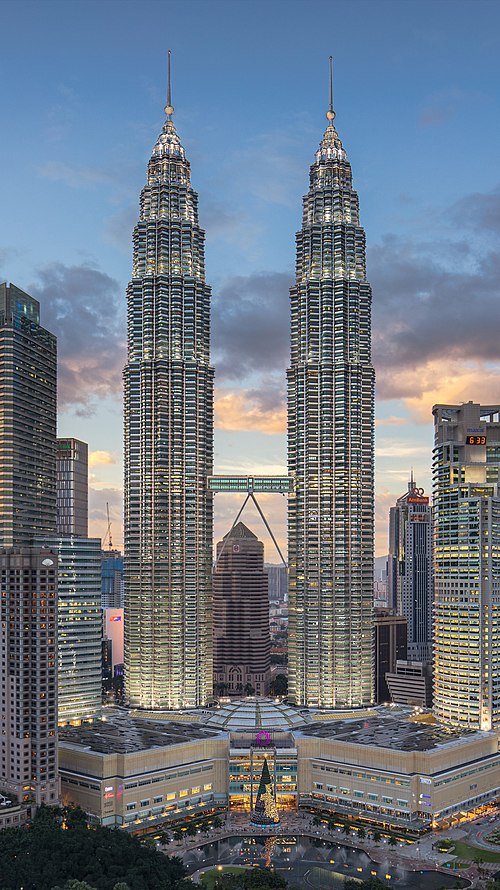
When Pelli received the commission for the Petronas Twin Towers, he approached it as both an architectural and cultural challenge. Rather than imposing a Western idiom on a Malaysian landmark, he immersed himself in Islamic art and geometry, studying the patterns and principles that had guided Islamic architects for centuries. The result was a design that felt simultaneously modern and deeply rooted in Malaysian cultural identity.
Pelli was awarded the AIA Gold Medal in 1995, partly in recognition of his work on the Petronas project. He continued designing buildings worldwide until his death in 2019, but the Petronas Twin Towers remain his most celebrated achievement — the project that defined both his career and a nation's skyline.
Adamson Associates Architects
While Pelli provided the creative vision, the Toronto-based firm Adamson Associates Architects served as the executive architect, responsible for translating Pelli's design into buildable reality. Founded in 1934, Adamson Associates had extensive experience with supertall buildings, having worked on projects across North America and Asia.
For the Petronas project, Adamson Associates managed the detailed architectural documentation, coordinated with the engineering teams, and oversaw the integration of building systems. Their expertise in large-scale commercial projects was essential to delivering a building of this complexity on schedule. The firm's role was critical in resolving the thousands of technical details that arise when constructing the world's tallest building — from elevator systems and fire safety to facade engineering and interior fit-out.
RSP Architects (Malaysia)
RSP Architects Planners & Engineers served as the local associate architect, providing essential knowledge of Malaysian building codes, local construction practices, and regulatory requirements. Their involvement ensured that the towers met all local standards while maintaining the design integrity envisioned by Pelli.
RSP's team worked closely with both the international architects and the Malaysian authorities, facilitating the complex approval processes and coordinating with local subcontractors. Their deep understanding of the tropical climate also influenced practical design decisions, from facade glazing specifications to rain management systems.
A Collaborative Triumph
The architectural team behind the Petronas Twin Towers represented a model of international collaboration. American vision, Canadian technical expertise, and Malaysian local knowledge combined to create a building that transcended any single cultural perspective. The result was architecture that belongs to the world while remaining unmistakably Malaysian — a feat that few buildings have achieved with such grace and conviction.
The collaborative approach extended beyond architecture to include structural engineers from Thornton Tomasetti & Ranhill Bersekutu, foundation specialists from Bachy Soletanche, and construction teams from Japan and South Korea. This international consortium, working under Malaysian direction, demonstrated that the most ambitious projects succeed when diverse expertise is channeled toward a shared vision.