Excavation and Site Preparation (1992–1993)
The construction of the Petronas Twin Towers began with the monumental task of preparing a site that Mother Nature had not designed for the world's tallest buildings. Planning commenced on January 1, 1992, and the project team quickly confronted their first major challenge: the site's geology.
The chosen location at the former Selangor Turf Club racecourse was found to straddle the boundary between two geological formations. The western portion sat on unstable decayed limestone, while the eastern portion rested on the more stable Kenny Hill formation of soft rock. Engineers made the bold decision to shift the entire building footprint 61 metres (200 feet) southeast, ensuring both towers would rest on the more dependable ground.
Excavation began in earnest on March 1, 1993. The operation was conducted primarily at night to minimize disruption to the surrounding area, with approximately 500 truckloads of earth removed each evening. Workers dug 30 metres below the surface, creating one of the largest excavation pits ever undertaken for a building project.
Foundation Work: Engineering at Record Depths
With bedrock lying far below the surface, the foundation design pushed the boundaries of geotechnical engineering. French specialists Bachy Soletanche were tasked with creating what would become the world's deepest building foundations. For each tower, 104 concrete piles were bored to depths ranging from 60 to 114 metres — some reaching nearly 375 feet underground.
The piles were capped by massive concrete raft foundations, each measuring 4.6 metres (15 feet) thick. The pouring of each raft was a logistical triumph: 13,200 cubic metres of concrete — enough to fill more than five Olympic swimming pools — was poured continuously over 54 hours without interruption. At the time, this was the largest single concrete pour ever recorded for a building foundation, a record that stood until 2007.
Rising from the Ground: The Superstructure
Construction of the superstructure commenced on April 1, 1994. Unlike most Western supertall buildings, which rely on steel frames, the Petronas Towers were built primarily from high-strength reinforced concrete. This decision was driven by several factors: the lower cost of concrete compared to imported steel, the greater familiarity of Asian construction workers with concrete techniques, and concrete's superior performance in reducing building sway — it is approximately twice as effective as steel in this regard.
The structural system employed was a tube-in-tube design. At the centre of each tower sits a 23-by-23-metre concrete core, surrounded by an outer ring of 16 super columns spaced at wide intervals. This arrangement provides enormous column-free office floors while delivering exceptional structural rigidity. The towers collectively offer 560,000 square metres of usable space.
Each floor took approximately four to five days to construct, with the towers rising at a rate of roughly one floor per week during peak construction. At the height of activity, more than 7,000 workers were employed on-site across both towers.
The Competitive Dynamic
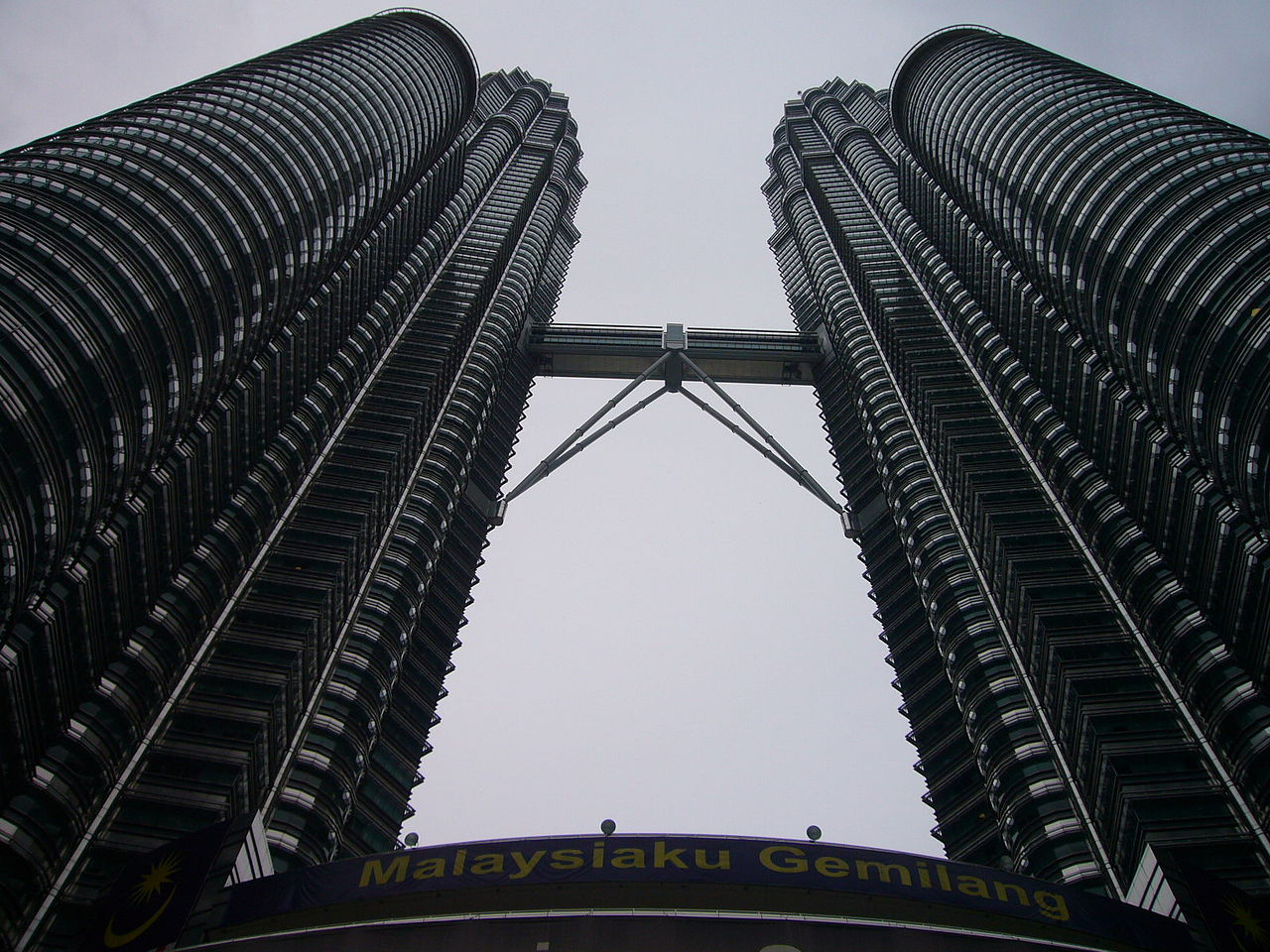
One of the most unusual aspects of the construction was the decision to assign each tower to a different international consortium. Tower 1 was built by a Japanese team led by Hazama Corporation (with JA Jones Construction and MMC Engineering), while Tower 2 was assigned to a South Korean consortium led by Samsung C&T Corporation (with Kukdong Engineering and Syarikat Jasatera).
This arrangement created an intense but productive rivalry between the two teams. Workers on each tower could see their counterparts' progress across the gap, creating a constant visual measure of relative performance. The Samsung-led team, despite starting approximately one month behind the Hazama team, ultimately completed Tower 2 first — a source of considerable pride for the South Korean builders.
Cladding and Interior Fit-out
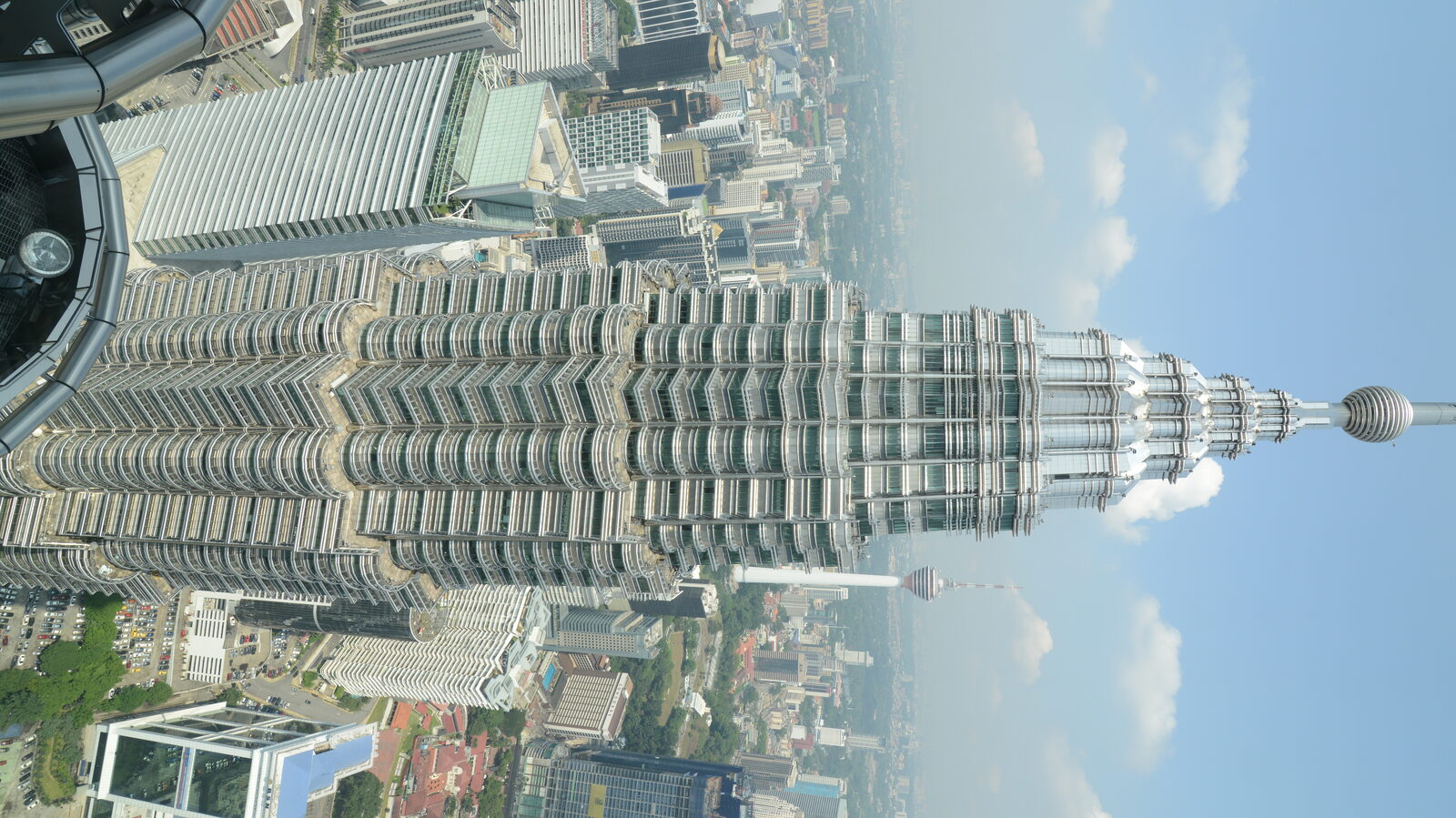
The towers' exterior facade consists of 33,000 stainless steel panels and 55,000 glass panels, designed to diffuse sunlight and reduce noise while creating the distinctive Islamic art motifs visible from the ground. The cladding system was engineered to handle Malaysia's intense tropical sun and heavy monsoon rains while maintaining the building's aesthetic integrity.
Interior work began even as the superstructure continued to rise. The towers feature state-of-the-art building systems including 78 elevators (29 double-decker), sophisticated fire safety systems, and an intelligent building management system that coordinates telecommunications, environmental controls, power supply, lighting, and security.
Completion and Legacy
The interior fit-out was largely completed by January 1996, and the iconic spires were installed by March 1996. The overall construction was declared complete in June 1996. The first Petronas employees moved into the towers on January 1, 1997, and the building was formally inaugurated on August 31, 1999.
The total construction cost was approximately US$1.6 billion — a figure that reflected not just the towers themselves but also the surrounding KLCC development including Suria KLCC mall, KLCC Park, the Petronas Philharmonic Hall, and extensive underground infrastructure.
Related Articles
The Contractors' Race
Foundation Construction